Unit 301 No. 6 Xianghong Road,Torch Hi-Tech Zone Industrial Park,Xiang'an District, Xiamen P.R.China
+86-13365922007
[email protected]



Intermittent Pneumatic Compression (IPC) equipment, widely known as air compression therapy devices, stands as a core physical rehabilitation product bridging clinical medical institutions and consumer wellness markets. Driven by surging demand for post-operative rehabilitation, lymphedema management, professional sports recovery and daily circulation care, multi-chamber gradient compression technology has become the standard configuration of mainstream medical recovery equipment. This article systematically deconstructs the core working principle of pneumatic compression therapy, differentiates the clinical value of 6-chamber segmented compression structure represented by VU-IPC04, analyzes its dual market application logic for medical institutions and end consumers, and interprets the industry technical iteration trend of medical-grade air compression devices.
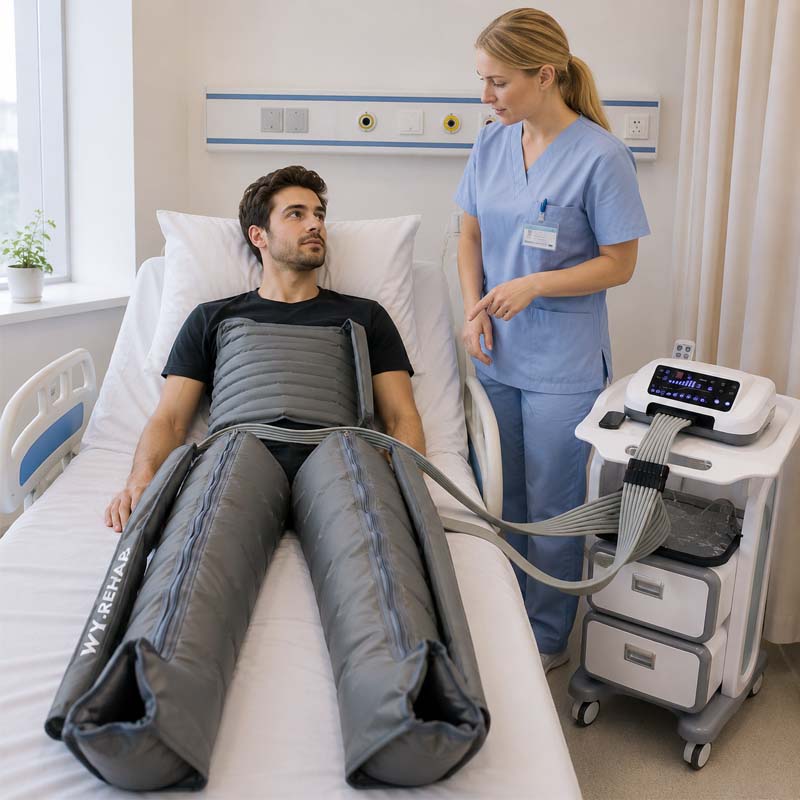
Pneumatic compression therapy adopts a distal-to-proximal sequential inflation & deflation logic, simulating the human body’s natural calf muscle pump function to form directional wave pressure circulation. The complete system consists of three core modules: intelligent pneumatic control host, multi-chamber air compression garment, and independent air delivery pipeline.
The technical workflow is divided into two cycles:
Inflation Stage: Independent air chambers inflate sequentially from the foot end to hip/glute area, generating adjustable gradient pressure (30–240mmHg for VU-IPC04). External mechanical squeezing pushes stagnant venous blood and interstitial lymph fluid back to the central circulatory system, eliminating limb fluid retention.
Deflation Stage: All chambers release pressure synchronously, restoring arterial blood perfusion to muscle tissues, improving microcirculation and tissue oxygen saturation, and accelerating lactic acid and metabolic waste excretion.
Traditional 2–4 chamber compression equipment delivers rough integrated squeezing, while the VU-IPC04 6-chamber segmented structure splits the lower limb into six independent pressure zones: foot, lower calf, upper calf, lower thigh, upper thigh, hip & glute.
Core technical highlights:
Single chamber independent switch: Each of the six chambers can be turned on/off separately to realize targeted intensive care for swollen parts;
6 preset professional massage modes (A-F): Single wave, squeeze, double wave, full squeeze, composite circulation, multi-function recovery, matching clinical rehabilitation, sports recovery, edema relief and other differentiated scenarios;
8 adjustable pressure gears + 1–90min stepless timing: Clinicians and individual users can customize treatment intensity according to edema degree, muscle soreness and physical tolerance.
As Class II medical devices, qualified pneumatic compression therapy equipment must pass ISO13485 quality system certification, FDA 510(k) clearance and CE-MDR medical device regulation certification. VU’s full series of compression devices adopt IEC 60601 medical electrical safety standards, built-in overpressure protection, low-noise stable air pump and universal 100–240V continuous-duty power supply, meeting long-term uninterrupted clinical use requirements without performance attenuation FDA Browse
For hospitals, rehabilitation clinics and long-term care facilities, pneumatic compression devices are standardized auxiliary treatment equipment with evidence-based medical support:
DVT Prophylaxis: Effectively reduce venous stasis of bedridden post-surgery patients, lowering the risk of deep vein thrombosis and pulmonary embolism, recommended as first-line physical intervention by vascular rehabilitation guidelines;
Chronic Lymphedema Management: Sequential gradient compression accelerates lymphatic drainage, relieving limb swelling after tumor resection, joint replacement and trauma surgery;
Chronic Venous Insufficiency Auxiliary Treatment: Improve varicose vein symptoms, reduce limb heaviness and recurrent venous ulcer incidence.
Professional sports teams, fitness clubs and athletic rehabilitation centers rely on IPC devices to solve delayed onset muscle soreness (DOMS):
Speed up lactic acid metabolism, shorten muscle recovery cycle after high-intensity training;
Eliminate exercise-induced interstitial edema, improve limb mobility for repeated training;
Non-invasive drug-free recovery scheme, no side effects compared with cryotherapy and painkillers.
Home & Gym Recovery Scenario
The miniaturized medical-grade compression equipment represented by VU-IPC04 breaks the clinical-only usage boundary, serving ordinary long-sitting office workers, the elderly, long-distance travelers and postpartum rehabilitation crowds:
Relieve daily lower limb fatigue, prevent sub-health varicose veins caused by sedentary/standing;
Improve peripheral circulation of elderly people with poor limb blood flow;
Portable modular garment design, suitable for sofa home self-care without professional therapist guidance.
For B-end distributors and OEM/ODM brand clients, medical-grade pneumatic compression devices feature broad market coverage and low after-sales cost:
Ultra-wide target user groups covering medical institutions, sports industry, home health, senior care, cross-border e-commerce;
VU supports low MOQ one-stop OEM/ODM customization: garment size, shell color, printed logo, multi-language interface and operation manual, helping brands launch exclusive compression therapy lines quickly;
Complete international medical certification reduces market access barriers for sales in North America, Europe, Australia and Southeast Asia.
Multi-chamber fine segmentation: 6-chamber becomes mainstream entry medical standard, high-end models upgrade to 8-chamber full-body compression garments for arms, waist and trunk;
Intelligent parameter personalization: Built-in biometric sensing modules, automatic pressure adjustment based on limb thickness and body weight;
Integrated multi-physical therapy: Combination of pneumatic compression + semiconductor cold-hot thermotherapy to realize dual recovery of circulation and inflammation relief;
IoT cloud linkage: New generation equipment supports data recording of rehabilitation cycles, forming long-term recovery tracking reports.
As analyzed in the previous industry trend report, the boundary between professional medical equipment and consumer wellness hardware continues to blur. Medical-grade 6-chamber air compression devices like VU-IPC04 perfectly fit this trend: they own full clinical certification to meet institutional bulk procurement, while lightweight, easy-operated design adapts household retail sales, becoming a core hot-selling category in the global rehabilitation equipment market.
With 16 years of intelligent rehabilitation equipment R&D and manufacturing experience, 300+ patents and a 20,000㎡ self-owned factory, Xiamen Weiyou Intelligent Technology optimizes the 6-chamber pneumatic compression system through independent R&D of air pump and control algorithm. The VU-IPC04 series balances clinical precision, household comfort and mass production stability, providing standardized medical recovery equipment and customized private-label solutions for global partners across 100+ countries.
Pneumatic compression therapy technology is not a simple massage hardware, but a systematic physical rehabilitation solution built on vascular and lymphatic physiological mechanisms. The 6-chamber independent gradient compression structure represented by VU-IPC04 maximizes the clinical efficacy of intermittent pneumatic compression through refined segmented control and multi-mode program customization. In the fast-growing global sports rehabilitation and home medical market, medical-grade air compression devices with complete international certification and mature OEM/ODM capacity will maintain sustained growth, and manufacturers with independent core pneumatic control technology will seize the dominant position in the global supply chain.
 EN