Unit 301 No. 6 Xianghong Road,Torch Hi-Tech Zone Industrial Park,Xiang'an District, Xiamen P.R.China
+86-13365922007
[email protected]



When medical distributors and hospital procurement teams look to upgrade their neurological recovery wards, hand therapy is often the most scrutinized category. The human hand is incredibly complex, and recovering its function after a stroke or spinal cord injury requires meticulous, high-volume repetition.
While manual therapy is the foundation of recovery, clinics simply do not have the manpower to perform thousands of daily finger flexions for every patient. This is why the hand finger rehabilitation robot has transitioned from a novelty to an absolute clinical necessity.
However, as a manufacturer producing intelligent medical care equipment since 2010, we frequently see B2B buyers make costly mistakes. They often source a generic hand finger rehabilitation robot based purely on price, only to find that it doesn't fit their patients, the software is too complex for therapists to use, or it lacks the necessary therapy modes.
If you are sourcing a hand finger rehabilitation robot for professional clinics or premium home-care channels, here is the ultimate buying guide focusing on what actually matters on the clinic floor: training modes, hand size fit, and usability.
A major pitfall in B2B procurement is buying a device that only performs one function. In the early days of this technology, an electric hand rehabilitation robot gloves system would simply force the hand open and closed. While this is fine for basic blood flow, it does very little for neuroplasticity.
Stroke recovery happens in stages. A clinical-grade hand finger rehabilitation robot must feature software-driven modes that adapt to the patient as they progress from total paralysis to active movement.
Anatomy is highly variable. If a distributor supplies a clinic with a "one-size-fits-all" hand finger rehabilitation robot, the product will fail.
When a finger recovery robot machine does not fit the patient properly, the mechanical joints of the glove do not align with the biological knuckles of the human hand. When the machine activates, it creates "joint sheer"—a painful pushing force against the finger bones rather than a smooth bending motion. This causes patient discomfort and immediate rejection of the therapy.
Sizing and Spasticity Considerations
When sourcing this equipment, you must partner with a manufacturer that provides a comprehensive sizing matrix (typically Small, Medium, Large, and Extra-Large, with specific pediatric options if needed).
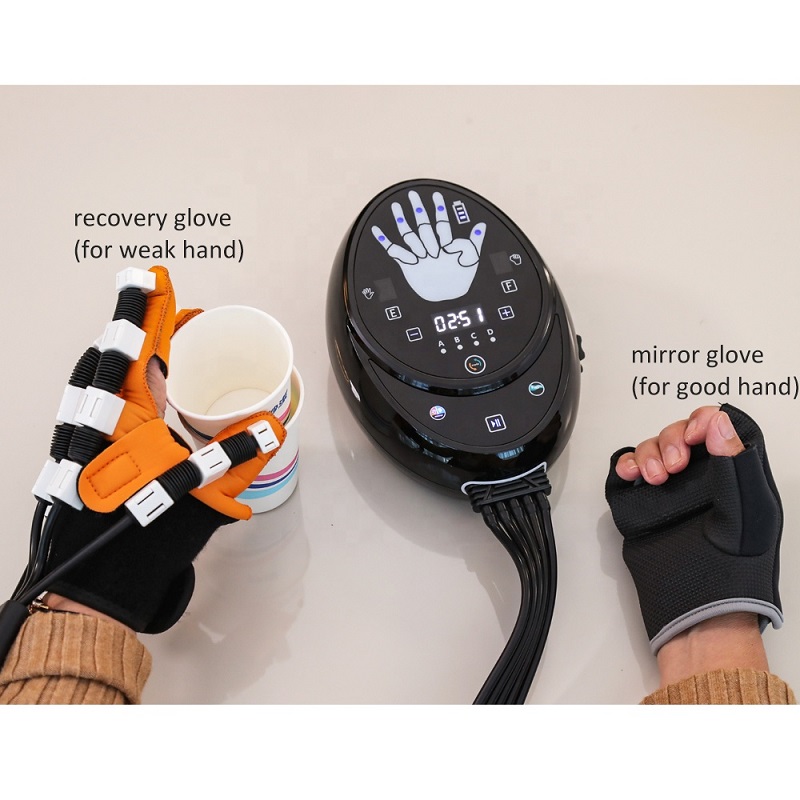
Furthermore, the material matters. Patients with hypertonia (severe muscle tightness) cannot have their hands forced into rigid plastic. Modern hemiplegia finger rehabilitation trainer robot gloves are built using soft, flexible polymers and biomimetic pneumatic air tubes. If a patient’s hand suddenly spasms, the pneumatic tubes safely absorb the resistance, whereas cheap rigid motors would fight the spasm and potentially cause injury.
Even the most technologically advanced hand finger rehabilitation robot will sit unused in a closet if it takes a therapist 15 minutes to set up. In a busy neuro-rehabilitation ward, time is money.
B2B buyers must evaluate the user interface (UI) and hardware setup of the hand finger rehabilitation robot.
To highlight the importance of fit and usability, consider an outpatient clinic network we supplied in North America. They had previously purchased a batch of budget-friendly hand robots from a consumer retail supplier. The gloves only came in two sizes, and the interface required a manual dial to adjust air pressure. Therapists hated them, and they were rarely used.
We replaced their inventory with our clinical B2B hand finger rehabilitation robot series. We supplied four distinct glove sizes per console and a one-touch LCD interface. Because therapists could instantly fit the glove to the patient and start a custom routine in under 60 seconds, the clinics saw a 30% increase in daily hand therapy sessions. The equipment achieved a complete ROI in just under three months, leading the network to standardize our devices across all their facilities.
To ensure you are stocking a product that will survive clinical demands and delight your B2B customers, use this quick-reference matrix when vetting a hand finger rehabilitation robot:
Sourcing Metric |
Consumer/Home Grade |
Clinical B2B Standard |
Impact on the End-User |
Glove Sizing |
Universal or 2 sizes |
Minimum 4 sizes (S to XL) |
Prevents joint sheer; ensures comfortable therapy. |
Pneumatic Control |
All fingers move together |
Individual finger isolation valves |
Allows for precise ADL pinch and grasp training. |
User Interface |
Manual dials / clunky buttons |
HD Touchscreen with saved profiles |
Saves therapists setup time in high-volume clinics. |
Actuation |
Rigid mechanics / wire pull |
Soft biomimetic pneumatic tubes |
Safely absorbs sudden muscle spasms without injury. |
Supplying neurological recovery equipment requires an intimate understanding of both the therapist's daily workflow and the patient's physical limitations.
By prioritizing multi-stage training modes, precise ergonomic sizing, and intuitive touchscreen usability, B2B procurement teams can source a hand finger rehabilitation robot that genuinely elevates clinical care. Partnering with an experienced manufacturer ensures you are not just selling a piece of hardware, but delivering a comprehensive, safe, and highly effective neuro-rehabilitation solution that hospital directors will trust for years to come.
 EN